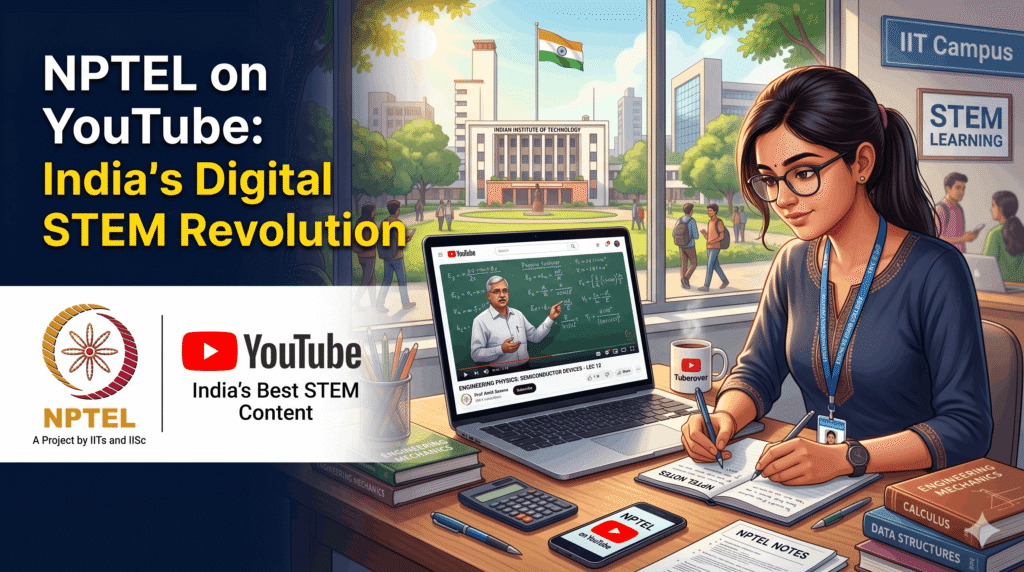
Over 2.2 million subscribers, 21k+ videos, 70,000+ hours of content & 1.3 Billion views with no fancy thumbnails. Does this channel ring a bell? Yes, you’re right if you thought about NPTEL.
YouTube is famous for creating digital stars and keeping people hooked on fast-paced content. But right next to all of those viral videos, sharing the exact same website, is something completely different.
It is one of the biggest and most serious science classrooms in the entire world. For millions of engineering and science students across India, YouTube is not just for fun. It is an essential tool for learning complex subjects.
This is all thanks to a massive project called the National Programme on Technology Enhanced Learning, or NPTEL for short.
NPTEL Project:
NPTEL as a project was created by India’s top colleges, including the Indian Institutes of Technology and the Indian Institute of Science. These are elite schools, and very few students get the chance to study there.
The professors at these colleges wanted to share their deep knowledge of science, technology, engineering, and math with everyone. Their goal was to record their classes and give them to students in smaller colleges across the country.
It was a beautiful idea, but they quickly ran into a massive technical problem. Hosting thousands of hours of video on the internet is incredibly hard and very expensive.
If NPTEL tried to build their own video website from scratch, it would have been a nightmare. Video servers crash easily when too many people try to watch at once.
Also, a custom video player might buffer constantly for a student who has a slow internet connection in a village.
The Youtube Masterstroke:
Instead of wasting money and time building a new website, NPTEL made a very smart choice. They decided to upload all of their college lectures directly to YouTube. This decision completely changed the game for online education in India.
By using YouTube, NPTEL instantly got access to the best video technology in the world. YouTube’s servers are built to handle millions of viewers at the exact same time without breaking a sweat.
Even better, YouTube automatically changes the quality of the video based on how fast your internet is. This meant a student in a big city with high-speed Wi-Fi could watch a chemistry lecture in full high definition, while a student in a rural area with a weak mobile signal could watch the exact same video without it stopping to buffer every ten seconds.
Using a platform that people already use every day also made learning much easier. Students did not have to download special software or learn how to use a clunky university website. They just opened the YouTube app they already knew so well.
The Content Quality Distinguisher:
What really makes the NPTEL YouTube channel so special is the actual content. Today, the internet is filled with short, ten-minute science videos. Those videos are fun, but they usually skip the hard math and just give a quick summary.
NPTEL does the exact opposite.
They do not care about making flashy videos to trick the YouTube algorithm. Instead, they upload full, unedited, fifty-minute college lectures. If you click on a playlist for computer science, aerospace engineering, or quantum physics, you are getting the real, hardcore science.
You are learning the exact same theories and complex mathematics as a student sitting inside an IIT classroom. For science students who want to truly understand how things work, this raw and deep information is priceless.
From a YouTube creator’s point of view, the success of NPTEL is actually quite shocking. Most experts will tell you that YouTube videos need to be short, loud, and full of fast cuts to keep people watching. They say that modern audiences have terrible attention spans.
NPTEL proves that this is completely wrong. Across their network of channels, they have millions of subscribers and have gathered well over a billion total views. They have uploaded tens of thousands of hours of long, serious lectures, and people watch them every single day.
This proves the amazing power of evergreen search traffic on YouTube. A deep lecture on civil engineering or basic thermodynamics recorded ten years ago is still highly valuable today because the laws of physics do not change.
Students are constantly searching for these exact topics to pass their exams, which means these old videos continue to get thousands of views year after year. It shows that if your video provides real, deep value to a specific audience, you do not need clickbait thumbnails to grow a massive channel.
NPTEL also used YouTube’s built-in text features to solve another major problem, which is the language barrier. Most advanced science and engineering classes are taught only in English.
This makes it very hard for smart students who grew up speaking regional languages to understand the material. To fix this, NPTEL used the platform’s caption and subtitle tools.
They spent a lot of time translating the English lectures into languages like Hindi, Tamil, Bengali, and Marathi. Now, a student can turn on the closed captions and read along in their mother tongue while the professor speaks.
This simple use of video technology opened the doors of science to millions of people who were previously left behind.