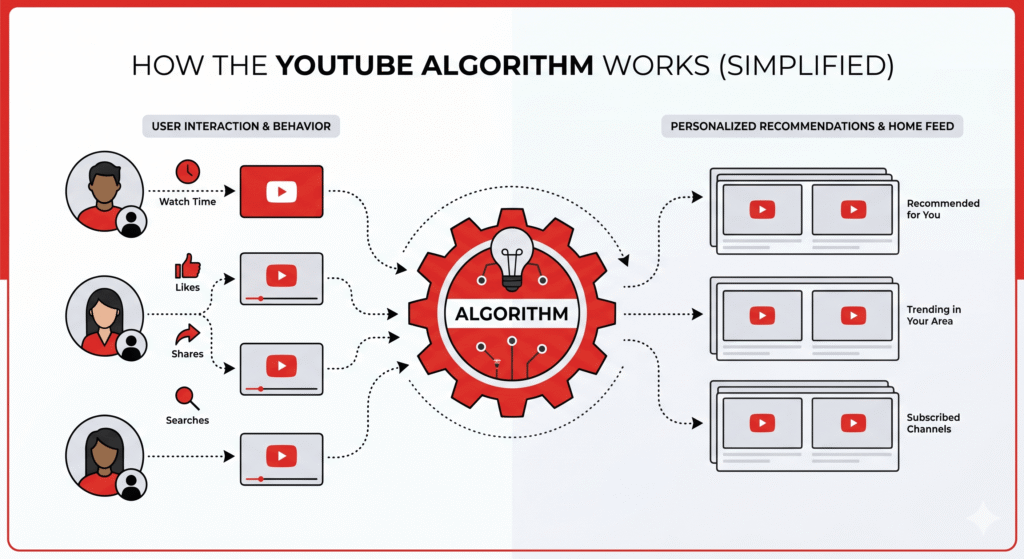
If you spend enough time in the YouTube creator space, you will inevitably hear “The Algorithm” spoken about like an all-powerful, unpredictable deity. It gets blamed for sudden drops in views and praised for viral successes. But what actually is it?
The YouTube algorithm isn’t a single piece of code designed to randomly judge content. Rather, it is a highly sophisticated, predictive recommendation system built entirely around one singular goal which is matching the right video to the right viewer at the exact right moment.
Let’s have a look at the technical architecture of how YouTube decides what shows up on a viewer’s homepage, explained in a way that actually makes sense.
Demystifying the Black Box
At its core, the YouTube algorithm is powered by deep neural networks. It operates at a scale that is genuinely hard to comprehend, processing hundreds of hours of newly uploaded video every single minute of the day.
Traditional recommendation algorithms such as the simple filters that might suggest a pair of shoes to you on an e-commerce site, completely break down at this magnitude.
Instead of pushing popular videos out to a broad audience, the system is fundamentally designed to pull videos in for an individual. It works backwards from the user.
When you open the YouTube app, the system does not ask, “What is the best video on YouTube right now?” It asks, “Based on this specific person’s history, time of day, and past behavior, what are they most likely to find deeply satisfying right now?”
The Three-Stage Architecture
To solve the massive scale problem, the recommendation engine uses a sophisticated funnel approach. It breaks the monumental task of sorting billions of videos into a distinct three-stage pipeline.
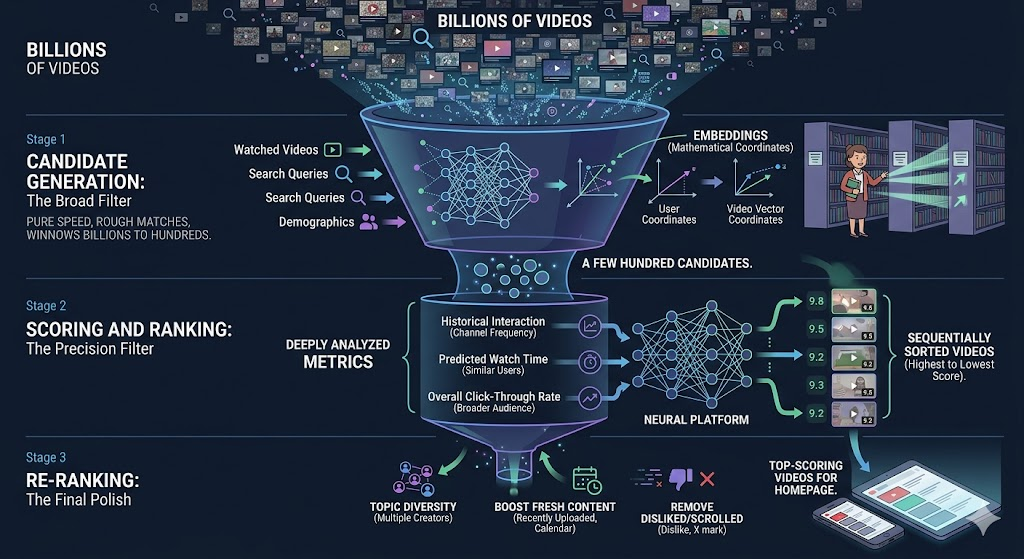
Candidate Generation: The Broad Filter
Imagine walking into the world’s largest library, containing billions of books, where you cannot possibly browse them all. Candidate generation is like a highly observant librarian who knows your general tastes and immediately points you to three specific aisles.
Technically, this first neural network takes your broad user history, including videos you have watched, search queries, and demographic data, and maps them into mathematical coordinates called embeddings.
It then compares your personal coordinates with the vector coordinates of billions of videos to find rough matches. The goal at this stage is not perfection; it is pure speed. In a fraction of a second, this system winnows the entire YouTube corpus down to a few hundred candidates that you might enjoy.
Scoring and Ranking: The Precision Filter
Once the system has a manageable list of a few hundred candidate videos, it brings in a much heavier, more precise neural network to score them. This network assigns a literal relevance score to every candidate video based on deeply analyzed metrics.
The ranking network looks closely at your historical interaction, calculating whether you have watched this channel before and how frequently. It also calculates a predicted watch time. By analyzing users with similar data profiles to yours, the system estimates exactly how long you are likely to watch this specific video.
Finally, it factors in the overall click-through rate, measuring how often the broader audience clicks this video when given the opportunity. The videos are then sorted sequentially from the highest calculated score to the lowest.
Re-Ranking: The Final Polish
Before those top-scoring videos actually appear on your screen, they go through one final algorithmic filter. Re-ranking applies specific constraints to ensure a pleasant user experience.
For instance, this layer ensures topic diversity so your feed isn’t entirely flooded with videos from the exact same creator.
It also boosts fresh, recently uploaded content to keep your homepage feeling current, and it quietly removes videos you have previously scrolled past or indicated you dislike.
The Core Signals That Matter Today
As the platform evolves, the artificial intelligence driving these networks has become incredibly nuanced. It is no longer just about generating raw clicks and basic watch time.
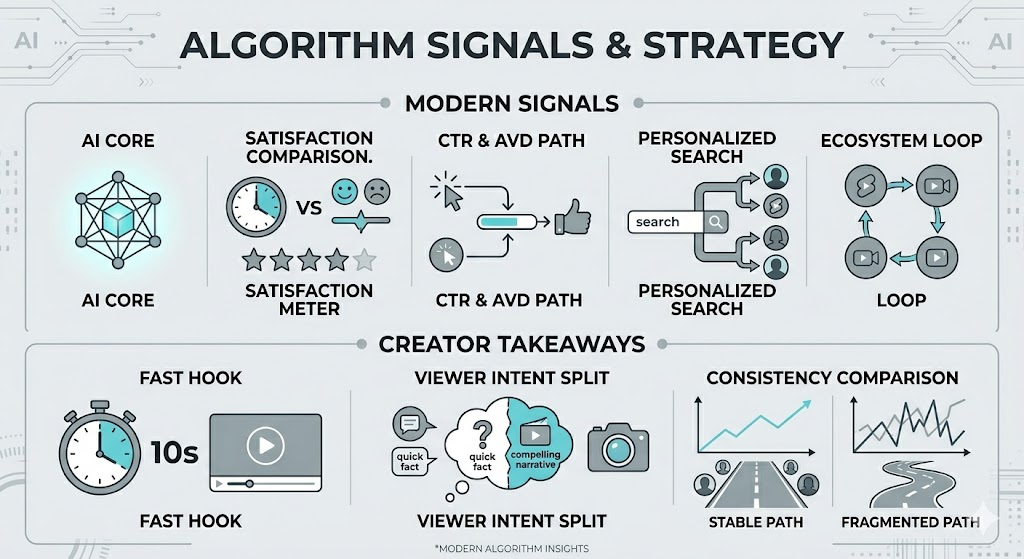
Measuring Satisfaction Over Raw Watch Time
YouTube has learned that a twenty-minute watch session does not matter if the viewer leaves feeling frustrated, misinformed, or click-baited. The algorithm now relies heavily on satisfaction signals.
This includes direct data from user surveys asking viewers to rate a video, analyzing repeat viewing patterns, and monitoring meaningful engagement in the comments section.
The Golden Combination of CTR and AVD
Click-through rate represents the promise you make to the viewer, and average view duration is the actual delivery of that promise. If your thumbnail gets the click, but your video does not hold attention, the algorithm quickly learns the video is not satisfying.
It will subsequently stop recommending it, regardless of how good the initial click rate was.
Hyper-Personalization in Search
Ranking number one in global search is largely an outdated concept. Because the system is so heavily tailored to the individual, two people searching the exact same phrase will often see entirely different results.
These customized results are based on their personal embeddings, past viewing habits, and preferred content formats.
Cross-Format Ecosystems
The recommendation engine now looks at a creator’s entire content ecosystem rather than judging videos in isolation. A viewer might initially discover your channel through a short-form video.
That interaction serves as a powerful, positive signal for the algorithm to naturally serve that same viewer your long-form content or live streams later in their session. All formats are deeply connected signals.
Strategic Takeaways for Creators
So, how do creators actually apply this highly technical knowledge? The fundamental secret is to stop trying to hack the code and start trying to understand human psychology.
Hook Fast and Deliver Immediate Value
Because the ranking network heavily penalizes early drop-offs, you must eliminate long, flashy introductions. Get straight to the point in the first ten seconds of your upload and immediately deliver exactly what the title and thumbnail promised the viewer.
Optimize for Specific Viewer Intent
Since the system relies heavily on personalized intent, you need to understand exactly why your audience clicked in the first place. If they are looking for a quick, factual answer, deliver it efficiently.
If they want an entertaining deep dive, build a compelling narrative. You must match your editing style and pacing to their specific underlying intent.
Maintain Consistency in Your Niche
Remember those mathematical coordinates from the candidate generation phase? If you suddenly switch from creating software tutorials to uploading daily travel vlogs, the algorithm becomes confused.
Your channel’s vector coordinates shift wildly, and the system no longer knows who to reliably show your videos to. Staying consistently in your specific lane is the best way to build a strong, predictive profile that the AI can trust.
Final Thoughts
The YouTube algorithm is not your enemy, nor is it a mystery designed to hold creators back. It is a highly efficient machine designed entirely to reflect human behavior at a massive scale.
If you focus deeply on giving real people a compelling reason to care, click, and stay engaged until the very end, the neural networks will happily do the heavy lifting of finding your ideal audience for you.