For years, the Indian corporate world viewed YouTube as a chaotic landscape of hobbyists, vloggers, and entertainment. It was seen as a stepping stone, a side hustle, or a digital playground.
But the numbers are officially in, and they have fundamentally rewritten the narrative: the Indian creator economy is now a highly formalized, massive driver of the nation’s gross domestic product.
According to the newly released YouTube India Impact Report based on independent research by Oxford Economics YouTube’s creative ecosystem contributed a staggering ₹18,000 crore to India’s GDP in 2025, up from ₹16,000 crore the previous year.
1. The Ecosystem Effect: 9.6 Lakh Jobs (And Counting)
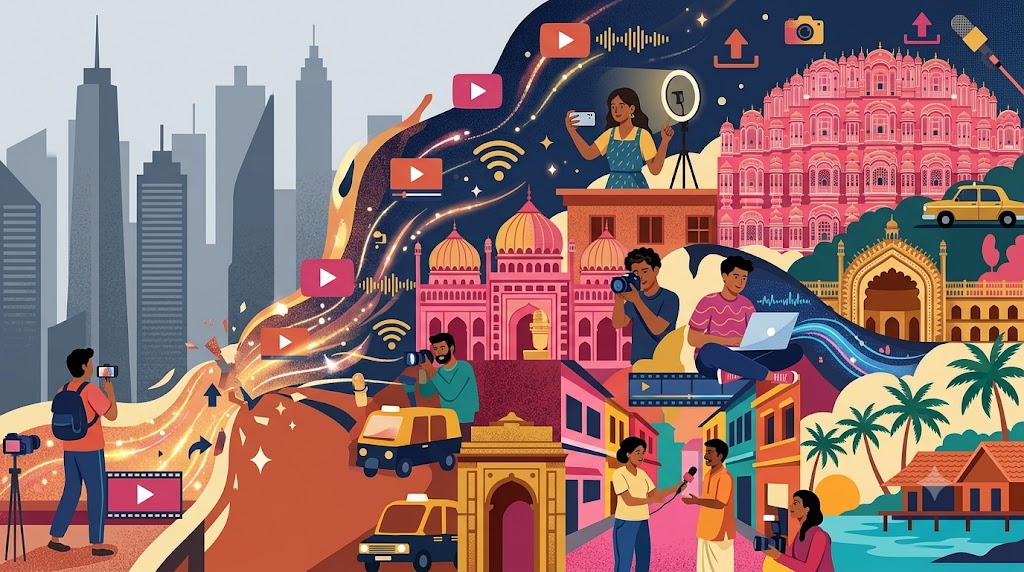
The most fascinating data point in the report isn’t just the revenue but the infrastructure. YouTube supported the equivalent of over 9.6 lakh full-time jobs in India last year.
However, this does not mean YouTube directly employed almost a million people, nor does it mean there are a million solo creators sitting in their bedrooms.
The modern YouTube channel is a small-to-medium enterprise (SME). Behind every successful person on camera is a sprawling network of production professionals: scriptwriters, cinematographers, thumbnail artists, lighting technicians, and dedicated video editors.
To be honest, the “Creator Economy” is a misnomer. It is actually the “Creative Service Economy.” If you are struggling to break through on camera, there is a massive, highly lucrative market in providing B2B services to established channels.
Creators are desperate for reliable editors and strategists who understand viewer retention and algorithmic packaging.
2. Breaking the Metro Monopoly
Historically, digital media was gatekept by massive production houses in Mumbai, Delhi, and Bengaluru. YouTube has completely decentralized this power.
The report highlights that the creator economy is rapidly spreading beyond the metropolitan hubs. Robust creative clusters are aggressively emerging in Tier-2 and Tier-3 cities like Jaipur, Lucknow, and Kochi.
Creators in these regions are leveraging their native languages and localized storytelling to build highly engaged, culturally resonant communities that traditional television networks could never reach.
So, to summarize, you do not need to move to Mumbai to build a media empire.
In fact, producing hyper-localized content in regional languages (Hindi, Tamil, Telugu, Marathi) currently offers a higher ceiling for community engagement and a lower barrier to entry than broad, English-first content.
3. From Hobby to Primary Income

The data paints a clear picture of professionalization: of the Indian creators who currently monetize their channels, a massive 73% now consider YouTube their primary source of income.
Furthermore, over 2 lakh Indian channels earned money for the very first time in the past year, and the number of channels generating six-figure annual revenues (in INR) grew by more than 30%. We are witnessing the extinction of the “starving artist” trope in the digital video space.
If YouTube is paying your rent, you can no longer operate on pure creative inspiration. You must treat your channel like a business.
This means investing in accounting software, setting up formal contracts for your freelance editors, tracking your Return on Investment (ROI) for camera gear, and optimizing your production workflows.
4. Going Global: Exporting Indian Culture
Indian creators are not just dominating the domestic market; they are becoming global cultural exports. The report reveals that more than 15% of watch time for content produced by Indian channels now comes from overseas viewers.
A locally produced video shot in a room in Kochi can now generate high-RPM ad revenue from audiences in the United States, the UK, or the UAE.
Furthermore, 81% of media companies present on the platform reported that YouTube directly helps them reach and monetize international audiences.
5. The AI Horizon and Skill Development
YouTube is not resting on its laurels. Recognizing the massive momentum in India, the platform is aggressively expanding its AI tools tailored for editing, channel management, and synthetic likeness detection.
Following a major announcement in May 2025, YouTube is injecting ₹850 crore over two years directly into India’s creator economy, heavily focusing on digital skilling alongside the Ministry of Information and Broadcasting.
AI is not going to replace the authentic creator, but a creator using AI will absolutely replace one who doesn’t. Now is the time to master generative AI tools for thumbnail ideation, script polishing, and title generation.
The Bottom Line
The ₹18,000 crore figure is not just a vanity metric for Google, it is proof of concept for your career. The days of explaining to your relatives that YouTube is a “real job” are over.
The platform has minted a new class of digital entrepreneurs, built a thriving job market for creative freelancers, and decentralized media distribution across the subcontinent.
The money is there. The audience is there. The only question left is: how are you going to structure your digital business to claim your piece of the pie this year?
“Every article on TubeRover is independently researched, fact-checked, and written by our editorial team. We skip clickbait, shortcuts, and unverified rumors to bring you accurate, high-signal insights that creators and viewers of youtube can rely on to navigate the YouTube ecosystem.”