
For most YouTube creators, monetization revolves around one main metric: Ad CPMs (Cost Per Mille).
You track ad impressions, optimize mid-roll placements, hope viewers don’t use ad blockers, and still brace for the well confirmed drop in revenue every January when advertiser budgets reset.
But what if your audience isn’t paying for your content through ad clicks?
What if 90% of your channel’s views come from YouTube Premium subscribers?
Having a high-Premium subscriber audience fundamentally transforms how a channel earns money.
It shifts your financial model from advertiser-driven monetization to subscription-pool sharing thus bringing higher revenue per view, immunity from ad blockers, and protection against seasonal ad budget impacts.
Here is a detailed analysis of what happens when your YouTube channel becomes dominated by Premium viewers.
We will see how the math works, and how you can optimize your content for maximum payout.
1. How YouTube Premium Revenue Actually Works
To understand the financial impact, you first have to look at how YouTube Premium pays creators compared to standard ads.
In a standard model, the advertiser bids on Google ads for youtube ad campaigns. Then the ad is served onto your channel videos. Then you get a payout on the basis of number of clicks and impressions the ad gathers.
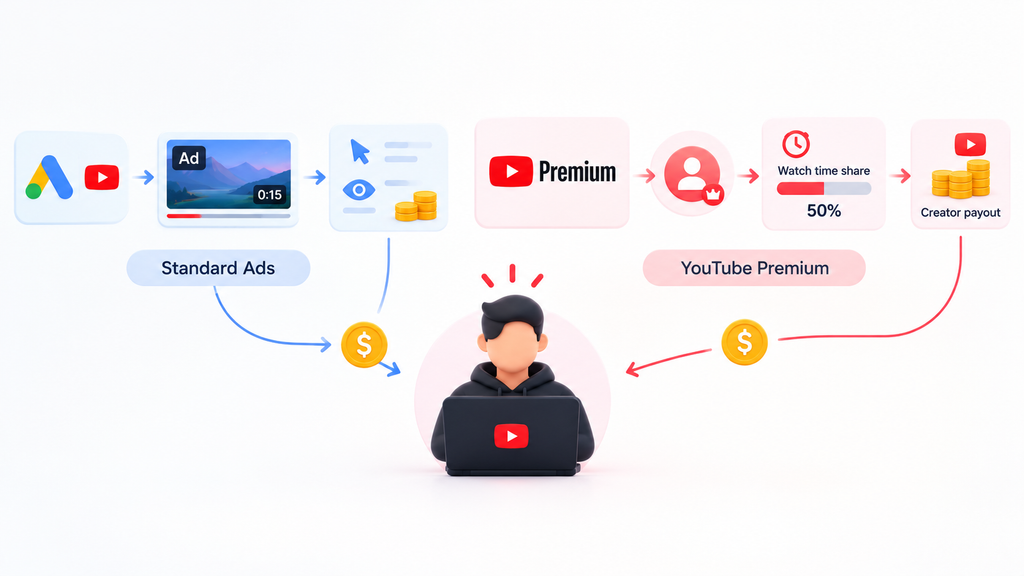
In the Premium model however, first the user buys YouTube Premium membership. Then, according to your channel’s watch share, the amount is directed to your payout from the creator portion.
The creator portion of that specific subscriber’s fee is basically distributed to channels based on their watch time relative to total watch time.
If a Premium subscriber spends 50% of their total YouTube watch time in a month watching your videos, you get 50% of their subscription payout budget, regardless of how many ads would have normally fit into those videos.
2. Key Earnings Impacts of a 90% Premium Audience
A Significant Jump in Overall RPM
On average across most niches, a Premium view pays significantly more than an ad-supported view.
Standard CPMs in mid-tier niches might range between $4 to $10 per 1,000 views, resulting in an RPM (Revenue Per Mille) of roughly $2 to $5.
Premium RPMs frequently range between $8 to $20+ per 1,000 views, especially if your content caters to high-income demographics or audiences in tier-1 countries (US, UK, Canada, Australia).
100% Protection from Ad Blockers
Ad blockers represent a massive hidden drain on creator revenue, particularly in tech, gaming, software, and finance niches where ad-block usage can exceed 40% to 50% of total desktop traffic.
With a 90% YouTube Premium audience, ad blockers become completely irrelevant.
Premium members do not see ads, but every single minute they watch generates revenue, ensuring 100% monetization of that viewer segment.
Freedom from Advertiser Seasonality
Traditional YouTube ad revenue is highly volatile.
Q4 (Nov–Dec): Advertiser spending surges for the holidays, driving CPMs to record highs.
Q1 (Jan–Feb): Corporate ad budgets reset, causing CPMs and creator earnings to plunge by 30% to 50%.
Because YouTube Premium revenue comes from recurring monthly subscriptions rather than brand ad spend, a 90% Premium channel experiences smooth, predictable monthly revenue year-round.
3. Comparison: Standard Ad-Supported vs. 90% Premium Channel
| Feature / Metric | Standard Ad-Supported Channel | 90% YouTube Premium Channel |
| Primary Revenue Driver | Ad impressions & click-throughs | Retention & total minutes watched |
| Impact of Ad Blockers | High (Unmonetized views) | Zero (100% monetized via subscription pool) |
| Q1 Revenue Dip | Severe (30%–50% drop) | Minimal (Stable subscription baseline) |
| Optimization Priority | Strategic mid-roll ad placement | Viewer retention & long session duration |
| Earning Scalability | Capped by ad inventory per video | Directly scales with video length & watch time |
4. How to Optimize Your Content Strategy for Premium Viewers
If YouTube Analytics shows that Premium subscribers make up the vast majority of your traffic, traditional advice on ad placements won’t help you maximize earnings.
Instead, adapt your channel strategy around watch time efficiency:
Focus on Retention Over Ad Triggers
When relying on ads, creators often stretch videos past 8 minutes just to place mid-rolls.
For Premium audiences, placing ads is unnecessary. Focus purely on keeping the viewer engaged:
- Eliminate long channel intros and filler.
- Maintain strong pacing to maximize Average Percentage Viewed (APV).
- Design bingeable end-screens to keep the subscriber on your channel for their entire viewing session.
Leverage Longer-Form Deep Dives
Since Premium payouts scale linearly with watch time, longer videos with high retention generate exponentially higher returns.
A 25-minute comprehensive essay or tutorial that holds a Premium viewer’s attention for 18 minutes will net significantly more revenue than three 6-minute videos combined.
Monitor Premium Metrics in YouTube Studio.
Track your performance by navigating to YouTube Studio —–> Analytics ——–> Revenue.
Compare your Premium RPM against your standard Ad RPM.
This allows you to evaluate exactly how much higher your paid subscribers value your content compared to standard ad auctions.
Final Takeaway
An audience comprised majority of YouTube Premium subscribers is one of the most financially advantageous positions a creator can hold.
It elevates your RPM, protects your channel against ad blockers and advertiser budget cuts, and rewards long-form, high-retention storytelling over aggressive ad placement.